Test and Simulation Exercises for Real-World Readiness Under Pressure
Ramsay Resilience Group helps organizations validate readiness before it is tested in real life. Our test and simulation exercises evaluate how teams execute response procedures, emergency procedures, and internal response protocols when pressure, uncertainty, time constraints, and simulated business incidents expose the gap between written plans and actual performance.
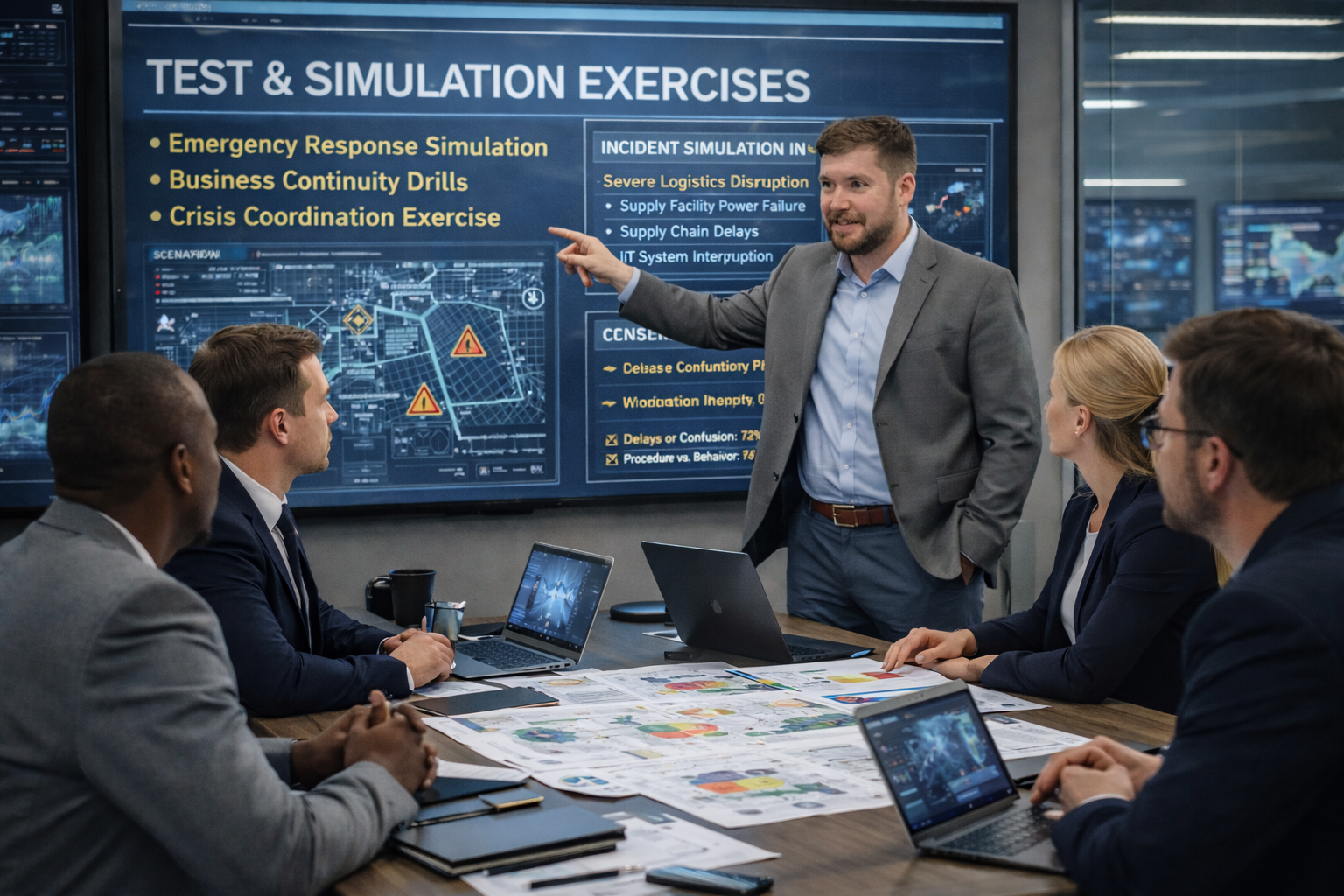
A plan that has never been tested is not a plan. It is an assumption.
Many organizations invest time and resources into building policies, procedures, and response frameworks. On paper, everything appears structured and complete. Roles are defined, steps are outlined, and expectations are clear. But when disruption occurs, those same plans often break down in execution.
That is not always because the plan was poorly written. More often, it is because the organization never validated how people would actually respond under pressure, uncertainty, evolving information, and time constraints. Test and simulation exercises bridge the gap between planning and performance by showing what the team will really do when conditions are no longer controlled.
Written Plans Hide Assumptions
Roles may look clear on paper, but uncertainty often exposes hesitation, confusion, or gaps in authority when teams are forced to act.
Communication Breaks First
During disruption, information often reaches the wrong people late, inconsistently, or without enough clarity to drive effective action.
Execution Reveals the Truth
Simulation creates a safe environment to identify where response procedures, emergency procedures, and internal protocols do not translate cleanly into action.
Readiness is not proven by documentation. It is proven by performance.
Ramsay Resilience Group designs test and simulation exercises to evaluate how your team responds when pressure, uncertainty, and time constraints are introduced. We do not evaluate how your plan reads. We evaluate how your organization performs.
Whether the foundation is a business continuity plan, emergency procedure, internal response protocol, or a scenario designed around likely operational risk, the purpose remains the same: identify the gap between what is expected and what actually happens.
The question is not whether your organization has a plan. The question is whether your team has proven they can execute it.
How we test response procedures under operational pressure
Effective test and simulation exercises must reflect the kinds of disruption your organization is actually likely to face. Ramsay Resilience Group builds scenario-based exercises grounded in operational reality, so leadership, teams, and departments can validate how response procedures, emergency procedures, and internal response protocols perform when uncertainty and time pressure are introduced.
Tabletop Simulations
Structured simulations focused on leadership decision-making, where leaders work through an evolving scenario in real time and reveal how effectively they communicate, prioritize, and coordinate under uncertainty.
Operational Walkthroughs
Floor-level exercises that evaluate how response procedures translate into action inside the environment itself, including role clarity, speed of execution, and where confusion or delays occur during a simulated business incident.
Full-Scale or Live Exercises
Higher-realism simulations that stress-test coordination across teams, departments, and leadership by introducing multi-layer disruptions that affect multiple parts of the operation at the same time.
Execution Gap Analysis
Across every exercise format, we identify the gap between what the organization expects to happen and what actually happens, so readiness can be improved through structure, training, and clearer response design.
Deliverables designed to turn testing into measurable improvement
Test and simulation exercises should produce more than observations in the moment. Ramsay Resilience Group structures every engagement to generate actionable outputs that help leadership understand what happened, where performance held, where response procedures broke down, and what needs to be improved before a real event forces the issue.
Comprehensive After-Action Analysis
A detailed breakdown of what occurred during the exercise, where performance was strong, where response gaps emerged, and how the organization performed under simulated pressure.
Decision-Making Delay Findings
Clear visibility into where hesitation, unclear authority, or delayed escalation slowed response, so leadership can refine structure and improve execution speed.
Communication Breakdown Analysis
Findings that reveal where information did not reach the right people in time, where messaging was inconsistent, or where critical details were lost during simulated disruption.
Procedure-to-Behavior Gap Review
A practical comparison between what written procedures expect and how employees or leaders actually responded during the exercise environment.
Actionable Readiness Recommendations
Clear recommendations for refining response procedures, emergency procedures, internal response protocols, training, and structural decision-making under pressure.
Continuous Improvement Direction
A roadmap for using simulation as an ongoing readiness cycle so response capabilities evolve as operations, systems, teams, and risk conditions change.
These deliverables are designed to turn testing from a one-time event into a structured improvement process, so confidence comes from validated execution rather than assumption.
A structured approach to testing plans, procedures, and response performance
Our process is designed to move from written structure to validated readiness. That means identifying what your organization already has in place, building realistic scenarios around likely disruption, observing how teams actually respond, and turning those findings into measurable improvement before real-world conditions force the issue.
Readiness Foundation Review
We begin by understanding the structure already in place, including business continuity plans, emergency procedures, internal response protocols, or the operational risks most relevant to your environment if no formal structure exists.
Scenario Design
We build scenario-based exercises grounded in realistic disruption patterns such as equipment incidents, system failures, communication breakdowns, workforce shortages, or supply chain interruption.
Live Evaluation of Response
We observe how leadership, teams, and departments perform under pressure, focusing on decision-making speed, role clarity, communication flow, coordination, and the gap between written procedures and actual behavior.
After-Action Analysis and Improvement
We translate findings into a comprehensive after-action analysis with practical recommendations that strengthen existing plans, improve response speed, and support ongoing readiness as operations evolve.
The result is a more validated, more executable, and more resilient response capability built on performance under pressure instead of assumption on paper.
Know how your team will respond before real conditions leave no room for hesitation
Ramsay Resilience Group helps organizations validate readiness through scenario-based test and simulation exercises that stress-test leadership, communication, coordination, and execution before an actual event exposes the gap.
Test and simulation exercises matter most where response speed, coordination, and safety cannot be left to assumption
This service is especially valuable for organizations that already have plans in place but lack confidence in how those plans will perform under pressure. It is also critical for leadership teams who want clarity on how their organization will actually respond, rather than relying on the assumption that documented procedures will automatically translate into effective action.
In operational environments where timing, coordination, communication, and safety are essential, untested plans create real exposure. The cost of uncertainty is not theoretical when incidents occur, systems fail, or conditions change unexpectedly.
- Warehousing and distribution operations
- Manufacturing facilities and industrial environments
- Leadership teams with existing response frameworks that have never been validated
- Organizations using business continuity plans, emergency procedures, or internal response protocols
- Teams exposed to communication breakdowns, equipment incidents, or workforce disruption
- Operations that need stronger execution under uncertainty and time pressure
- Organizations seeking confidence through validation instead of assumption
The more complex the operation becomes, the more important it is to validate not just the plan itself, but the organization’s ability to execute it under pressure.
Built for organizations that want proof of readiness, not just documented intent
Strong test and simulation exercises give leadership clearer visibility into how teams make decisions, how communication actually flows, where procedures break down in execution, and what improvements will most strengthen readiness.
The result is faster decision-making, stronger coordination, more reliable response procedures, and a clearer understanding of how the organization performs when pressure, uncertainty, and time constraints are introduced.
For many organizations, the greatest weakness is not the absence of a plan. It is the absence of proof that the plan can be executed when real-world conditions no longer allow time to figure things out.
Answers about test and simulation exercises
These are some of the most common questions organizations ask when evaluating test and simulation exercises, response procedure validation, emergency procedure execution, and after-action analysis.
What is the purpose of test and simulation exercises?
The purpose is to validate how your organization actually performs under pressure. These exercises reveal how leadership, teams, and procedures respond when uncertainty, evolving information, and time constraints are introduced, so readiness can be improved before a real incident tests it.
Do we need formal plans in place before running an exercise?
No. If your organization already has business continuity plans, emergency procedures, or internal response protocols, those can be used as the testing foundation. If no formal structure exists, exercises can still be designed around the realistic operational risks most relevant to your environment.
What types of scenarios can be simulated?
Scenarios can include equipment incidents, system failures, communication breakdowns, workforce shortages, supply chain interruption, and other disruptions that reflect real operational patterns in warehouse, manufacturing, distribution, or similar environments.
What usually gets uncovered during a simulation?
Common findings include decision-making delays, unclear authority, communication breakdowns, inconsistent execution, and gaps between written procedures and actual behavior. These exercises make those issues visible in a controlled setting where improvement is still possible before real-world consequences occur.
What outcome should we expect from a test and simulation exercise engagement?
Depending on scope, outcomes may include a comprehensive after-action analysis, findings on decision delays and communication breakdowns, procedure-to-behavior gap review, actionable readiness recommendations, and a stronger continuous improvement cycle for response capability.
When an actual event occurs, there is no time to figure things out. There is only time to respond.
Test and simulation exercises provide something documentation alone cannot: confidence through validation. They allow your team to experience disruption in a controlled environment, make decisions under pressure, identify weaknesses, and improve before those weaknesses are exposed in real time.
Ramsay Resilience Group helps organizations validate response procedures, strengthen coordination, improve communication flow, and build readiness that has been tested instead of assumed.