IT Resilience and Disaster Recovery Consulting for Business Continuity
Ramsay Resilience Group helps organizations reduce downtime, protect critical operations, and maintain control when systems fail. Our disaster recovery and IT resilience consulting services are built for real-world environments where orders, communication, visibility, and leadership decisions must continue while systems are being restored.
Disaster recovery planning for businesses starts with what happens before systems come back online
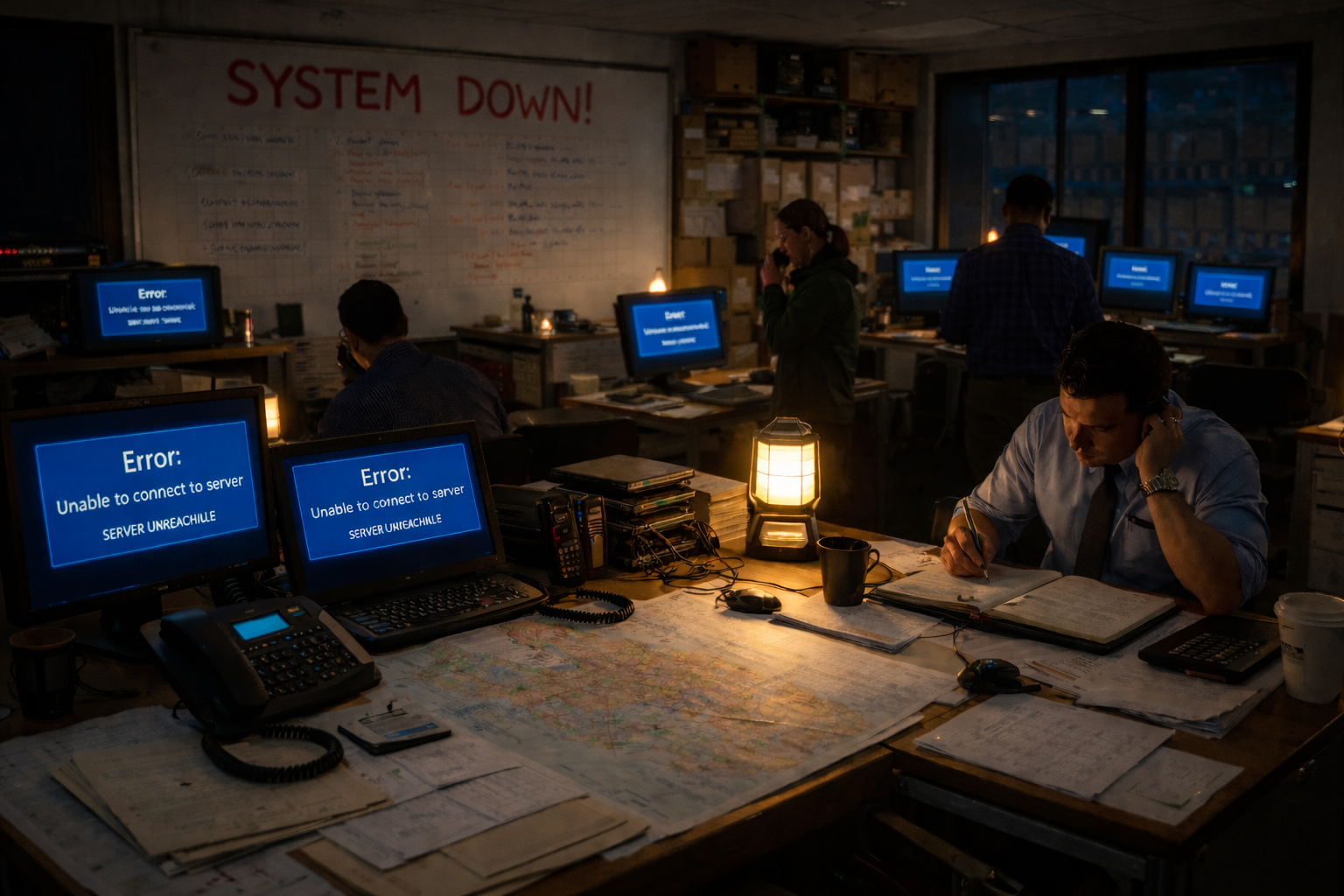
Most businesses assume backups are enough. Data can be restored. Infrastructure can be rebuilt. But disaster recovery services are only part of the equation. The real risk appears in the first hour, the first shift, and the first day of a systems failure recovery event, when teams still need direction, orders still need to move, and decisions still need to be made with limited visibility.
That is where business continuity consulting, IT continuity planning, and operational resilience consulting matter most. When warehouse management systems, ERP platforms, automation controls, communication tools, and other critical systems fail, downtime reduction depends on whether your team has a practical continuity strategy already in place.
Visibility Breaks Down
Teams lose access to the information they rely on to process work, coordinate labor, and maintain service levels.
Improvisation Increases Risk
Without fallback procedures, manual workarounds create delays, fragmented communication, and avoidable mistakes.
Recovery Priorities Blur
When everything feels urgent, organizations often waste time restoring the wrong systems in the wrong order.
Backups restore data. Business continuity protects operations.
Ramsay Resilience Group helps organizations reduce downtime and protect critical operations with disaster recovery consulting, IT resilience consulting, and recovery planning that bridge the gap between system failure and full restoration.
Our focus is not only on rebuilding systems. It is on making sure your business can continue forward with control, clarity, and purpose while recovery efforts are actively underway.
The question is not whether your systems can eventually come back. The question is whether your operation can continue while they do.
What our disaster recovery and IT resilience consulting helps you put in place
Effective disaster recovery consulting and business continuity consulting must go beyond technical restoration alone. Ramsay Resilience Group helps organizations build the structures, priorities, fallback procedures, and testing discipline needed to reduce downtime, strengthen infrastructure resilience, and protect critical operations when systems fail.
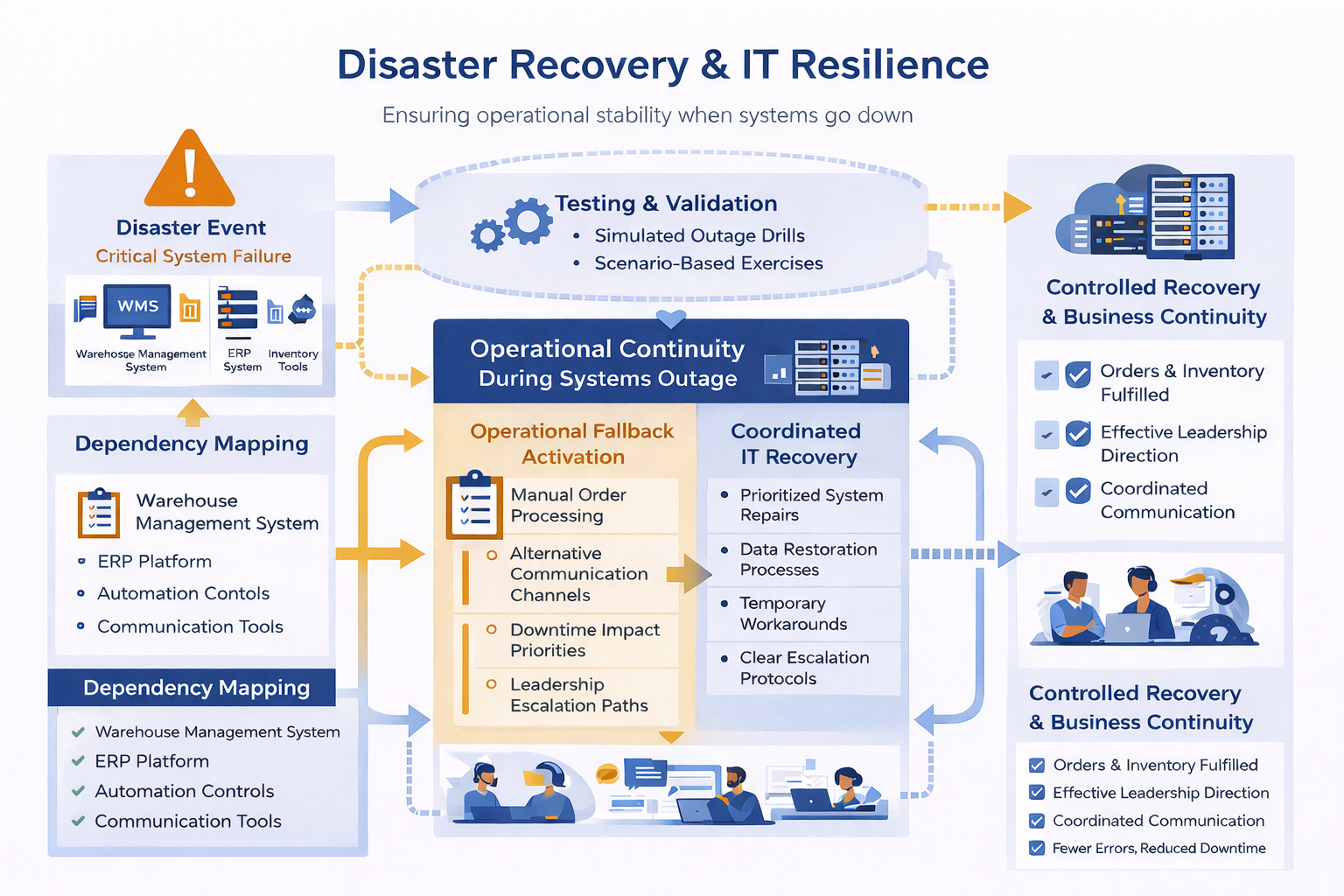
System Dependency Mapping
Identify the platforms, workflows, and operational dependencies that create the greatest exposure if they fail, so your continuity strategy reflects how the business actually works.
Downtime Impact Analysis
Prioritize recovery planning according to operational consequence, service commitments, and business continuity needs so the most important work is protected first.
Operational Fallback Procedures
Build practical fallback workflows, manual processes, and escalation structures that support business continuity services in real operating conditions.
Testing and Validation
Validate incident response planning, recovery planning, and continuity planning for critical business systems before a real disruption exposes gaps.
Reduce downtime and protect operations with a clear continuity strategy
Effective IT resilience consulting is not about eliminating every disruption. It is about building a structured response that keeps critical operations moving while infrastructure resilience and systems failure recovery efforts continue in parallel.
Our business continuity consulting services help leadership teams make faster, more confident decisions by defining what must be restored first, what can operate in a degraded state, and what can continue through practical fallback workflows.
- Clearer recovery priorities across departments and systems
- Reduced downtime confusion and avoidable errors
- Stronger coordination between leadership, operations, and IT
- More confident decisions when visibility is limited
- Continuity strategies that protect critical operations under pressure
The goal is not just to restore technology. The goal is to maintain stability, direction, and operational control while recovery is underway.
Deliverables designed to improve clarity, execution, and control
Our disaster recovery consulting and business continuity consulting engagements are designed to produce usable outputs, not just discussion. The goal is to give your organization practical tools for continuity planning, recovery planning, and critical operations protection when systems fail.
System Dependency Map
A clear view of how your operation depends on core platforms, workflows, reporting tools, communication systems, and visibility layers across the business.
Downtime Impact Framework
A structured recovery prioritization model based on operational consequence, service commitments, labor impact, and business continuity risk.
Operational Fallback Playbooks
Practical step-by-step workflows your team can follow during disruption when critical systems, automation layers, or communication tools are unavailable.
Escalation and Communication Guidance
Defined coordination structures between leadership, operations, and IT so incident response planning remains aligned under pressure.
Testing Recommendations
Validation guidance and structured testing priorities to help confirm whether your recovery planning and continuity strategy will hold up in real conditions.
Continuity Strategy Recommendations
Practical recommendations for reducing downtime, protecting critical operations, and strengthening infrastructure resilience as your operation grows in complexity.
These deliverables are intended to make your response more structured, more practical, and more executable under pressure, so your business continuity approach supports real operations instead of remaining theoretical.
A structured approach to disaster recovery planning and business continuity consulting
Our process is designed to move from operational exposure to practical continuity strategy. That means identifying where disruption will hit hardest, clarifying what must keep moving, and building a recovery planning framework your teams can actually use under pressure.
Discovery and Operational Review
We review your environment, critical systems, workflow dependencies, leadership structure, and the areas where downtime would have the greatest business impact.
Dependency and Risk Assessment
We identify where systems failure recovery challenges would affect throughput, communication, labor efficiency, service commitments, or visibility most severely.
Continuity and Recovery Planning
We define recovery priorities, fallback procedures, escalation paths, and continuity strategies aligned to the realities of your operation.
Testing and Refinement
We help validate the plan, identify weak points, and strengthen readiness through testing, review, and continuous improvement.
The result is a more structured, more executable, and more resilient approach to business continuity, incident response planning, and disaster recovery consulting.
Know where your operation is exposed before downtime exposes it for you
Ramsay Resilience Group delivers disaster recovery consulting, IT resilience services for small business and growing organizations, and business continuity consulting services that strengthen operational control before failure becomes disruption, delay, or loss.
Where our business continuity and disaster recovery consulting delivers the most value
This service is especially valuable for organizations where downtime directly affects revenue, customer commitments, labor efficiency, compliance, visibility, or employee safety. As systems become more integrated, infrastructure resilience, recovery planning, and continuity strategy become essential to sustained performance.
Disaster recovery and IT resilience consulting is often most urgent where operations depend on timing, coordination, digital workflows, inventory visibility, automation, or rapid communication across teams and departments.
- Warehousing and distribution operations
- Logistics and fulfillment environments
- Manufacturing facilities and production environments
- Multi-site operations with shared systems and workflows
- Process-heavy service organizations
- Small and mid-sized businesses with growing system dependency
- Teams that need to reduce downtime and protect critical operations without enterprise bureaucracy
This work is particularly valuable when even a short outage can create missed commitments, manual errors, leadership confusion, or downstream operational disruption.
Built for organizations that cannot afford prolonged confusion when systems fail
Strong disaster recovery consulting and business continuity consulting gives leadership a usable framework for continuity planning, incident response planning, and systems failure recovery before disruption occurs.
The result is a more coordinated response, clearer accountability, better recovery prioritization, and stronger protection for the processes, people, and commitments your business depends on every day.
For many organizations, the biggest risk is not the outage itself. It is the lack of structure around what happens next. That is the gap this service is designed to close.
Answers about disaster recovery consulting, IT continuity planning, and business continuity services
These are some of the most common questions organizations ask when evaluating disaster recovery planning, operational resilience consulting, and continuity strategy support for critical business systems.
What is the difference between disaster recovery consulting and business continuity consulting?
Disaster recovery consulting focuses on restoring systems, infrastructure, and data after an event. Business continuity consulting focuses on keeping critical operations functioning while recovery is underway. Effective disaster recovery and IT resilience consulting requires both.
Do disaster recovery services only apply after a system goes down?
No. The strongest disaster recovery planning for businesses happens before a failure occurs. The goal is to reduce downtime, protect operations, and put continuity strategies in place before critical systems are unavailable.
How does IT resilience consulting help reduce downtime?
IT resilience consulting helps reduce downtime by identifying system dependencies, defining recovery priorities, creating fallback procedures, improving incident response planning, and aligning restoration efforts with real operational needs.
Is this relevant for smaller organizations or only large enterprises?
It is relevant for both. IT resilience services for small business are often just as important because smaller teams usually have less redundancy and fewer resources to absorb extended disruption.
What outcome should we expect from an engagement?
Depending on scope, outcomes may include system dependency visibility, downtime impact analysis, operational fallback playbooks, continuity strategy recommendations, incident response planning improvements, and a clearer path for systems failure recovery.
When systems fail, your operation should continue forward with clarity and control
If your business depends on technology to fulfill orders, direct labor, maintain visibility, coordinate teams, or protect customer commitments, your resilience strategy needs to account for more than restoration alone.
Ramsay Resilience Group provides disaster recovery consulting, IT resilience consulting, and business continuity consulting built for organizations that need practical recovery planning, stronger continuity strategy, and reduced downtime when disruption occurs.